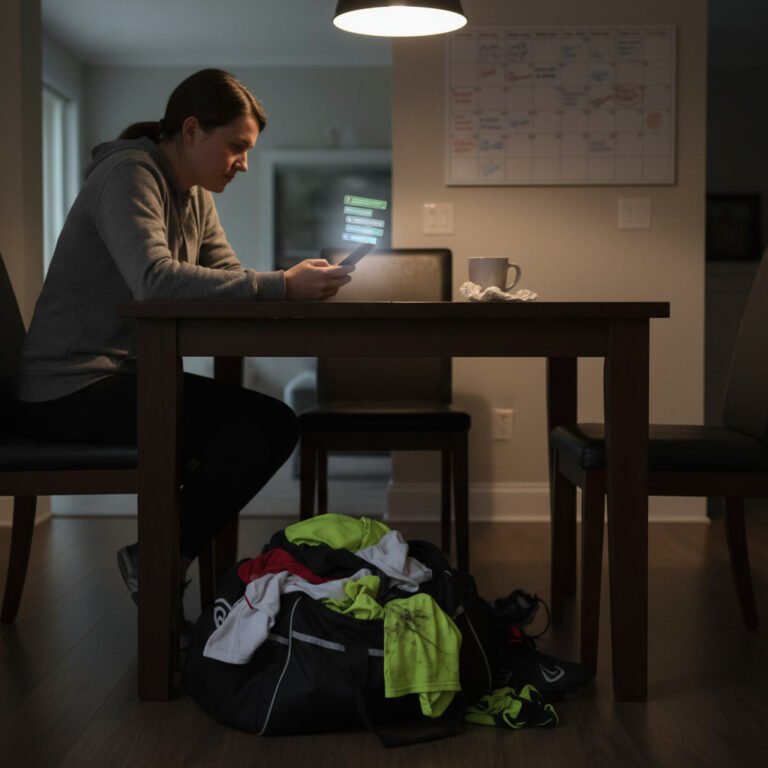

The Morning Chaos
How to talk to a coach without turning the sideline into a soap opera is one of those parenting mysteries that should earn you a medal. You’d think after seven seasons of early morning tournaments, I’d have learned not to set the alarm for “wishful thinking o’clock.” But here we are again: I’m half-awake, fumbling for a coffee mug, and mumbling things that make my kid look at me like I’m summoning demons. It’s 6:12 a.m., the car still smells like cleats, and I’m already psyching myself up for what might be The Conversation, the one with Coach that every parent eventually has and every kid prays we don’t.
I pour caffeine into my emotional-support tumbler, trying to remember that my mission today is not to go viral for the wrong reasons. The kid’s in the back seat, AirPods in, pretending I don’t exist. I glance at him in the mirror. He’s calm. I’m sweating. This is how every youth sports war story begins, with a parent overthinking every substitution that hasn’t even happened yet.
By the time we hit the field, the parking lot is already full of SUVs and the smell of anxiety. You can feel it in the air, the unspoken tension of parents rehearsing what they’d say to the coach if they ever found the guts. And that’s when I realize: today’s the day I’m going to talk to the coach. I just don’t know it yet.
The Pre-Game Parent Jungle

There’s a whole ecosystem on the sideline. You’ve got the Silent Observers, those Zen masters who fold their chairs and sip coffee like nothing phases them. Then there are the Stat Trackers, armed with clipboards and conspiracy theories. And of course, the Encouragers who yell “HUSTLE!” every six seconds even though nobody’s listening.
I take my seat somewhere in the middle, Switzerland basically, trying to look casual while scanning for the Coach. He’s across the field, clipboard in hand, looking like a general plotting a minor invasion. My brain starts its usual nonsense: Should I ask about more playing time? Should I wait till next week? Should I just run away and join a yoga retreat instead?
The mom next to me leans over and whispers, “I heard he’s moving kids around again.” I smile, but my heart rate jumps. And that’s how rumor season begins, one whisper, one sideways glance, one overly long Facebook post in the team group chat.
I remind myself of the twenty four hour rule, you don’t approach the coach right after a game. It’s like arguing with TSA. No one wins. I even wrote about it once on Sideline Legends, you can check it out here: Sideline Excuses post if you want proof that adrenaline and logic don’t share a brain cell.
Warm-Ups & Worries
The players stretch, the whistle blows, and my child jogs onto the field looking confident. I sit back, pretending to be chill while mentally calculating minutes played like I’m running NASA telemetry. Around me, parents start their small-talk therapy sessions.
“Do you think Coach even likes our kids?” someone mutters. Another responds, “He just favors the faster ones.” It’s never malicious at first, just insecurity wrapped in caffeine. I sip my drink and think: this is how people accidentally start World War Sideline.
It’s not that coaches are untouchable gods. They’re just humans juggling strategies, egos, and twenty-three parents who all think their kid is the secret weapon. But from this side of the line, it’s easy to forget that.
A dad behind me starts pacing. You can always tell he’s building up to something, the same way you can tell a toddler is about to melt down in Target. Every sigh is louder than the last. I make a note to pack Calm Aid Gummies next time, for me or him, it doesn’t matter.
Kickoff: The Sideline Spiral

The whistle blows. Within thirty seconds, someone yells “Call that, ref!” and all composure is gone. Parents shift from “supportive” to “unhinged sports analysts.”
I try to focus on my kid, who’s hustling but clearly overthinking every touch. I feel that protective surge, the one that makes parents transform into unpaid public defenders. But I stay quiet. Mostly.
Halfway through the first half, Coach subs him out. And my entire nervous system lights up like a stadium scoreboard. My brain starts drafting the confrontation email in real time: Dear Coach, With all due respect…
Then I catch myself. Deep breath. Remember the 24-hour rule. I shove another sip of coffee down like medicine. This isn’t about me. It’s about the kid learning, improving, and maybe, hopefully, surviving my over involvement.
Across the field, Coach is explaining something to the new sub. Calm. Focused. Intentional. I realize he’s not ignoring anyone; he’s just coaching. But logic doesn’t always win when emotions are refereeing.
Halftime: The Moment of Truth (Almost)

The whistle for halftime blows, and the parents start their march, the Great Snack Migration. I grab the cooler and pretend to check on hydration, but really, I’m hovering within ten yards of Coach like a satellite with unresolved issues.
He’s surrounded by kids now, giving quick feedback: positioning, spacing, effort. You can tell he’s trying to build them up. It’s not personal, it’s purposeful. My son glances over and shrugs, the universal sign for “Please don’t talk to Coach right now, I beg you.”
So I don’t. I hand him his drink, pat him on the head, and say, “You’re doing great.” He knows I mean it. And somehow, for once, that feels like enough.
But of course, the game’s not over. There’s still the second half and the parking lot, where most sideline wars are either won, lost, or escalated.
Second Half: The Emotional Rollercoaster
The second half begins with renewed hope and a caffeine buzz that could power a city block. Parents settle into their battle stations, cooler lids creaking open like the gates of Valhalla. The sun’s higher now, which means the kids are slower and the opinions are louder.
I’m watching my kid on the bench, head tilted down, kicking at the grass. He’s not sulking, just thinking. But as every parent knows, that quiet stare can pull at your chest like an anchor.
Coach calls him back in. A new burst of adrenaline hits. He hustles, makes a good play, then misses a pass. I physically clutch my chair’s armrest like I’m holding onto sanity itself.
And then I hear it, that one parent who yells, “Come on, Coach, that’s not fair!” And suddenly, you can feel the collective cringe. Even the referee looks over. This is how communication collapses, not with a scream, but with a poorly timed shout from the peanut gallery.
The Post-Game Silence
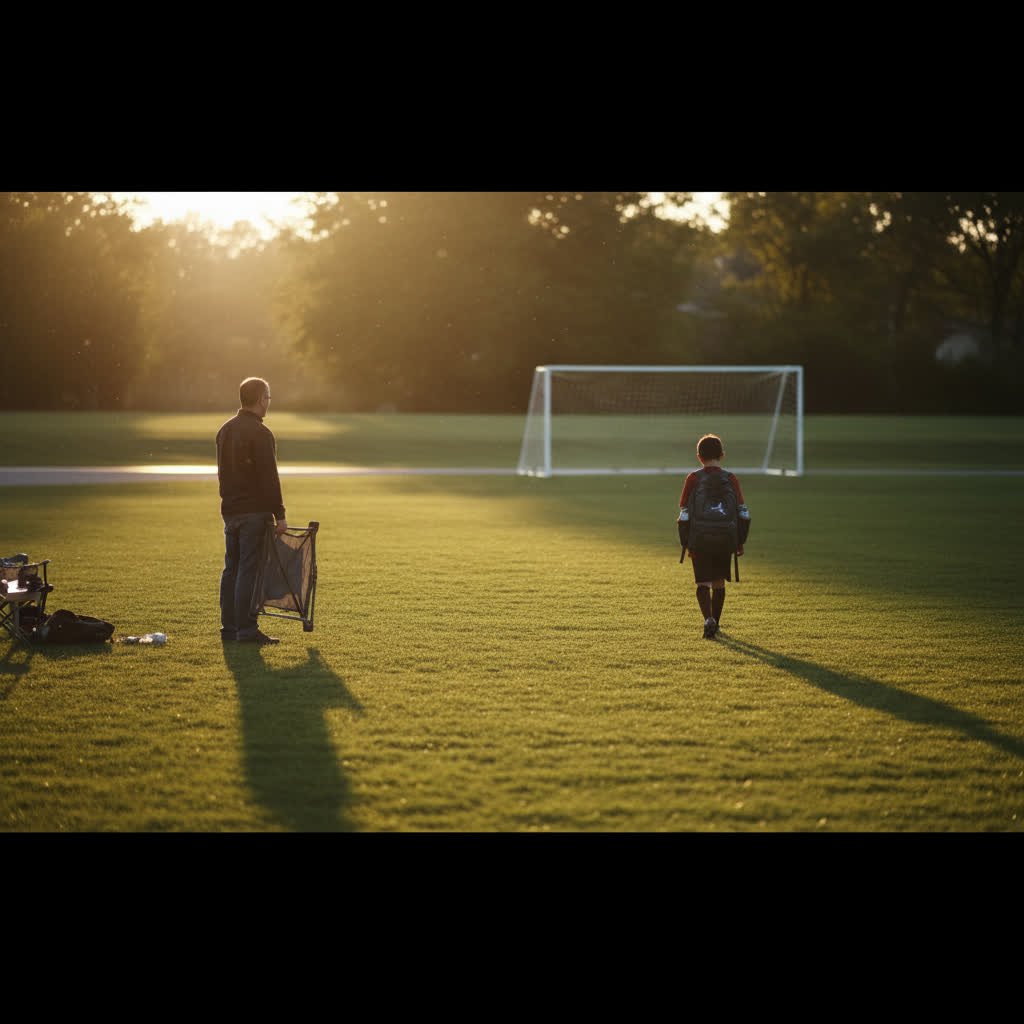
After the final whistle, no one moves right away. The kids line up to shake hands; the parents pretend to scroll their phones to avoid eye contact with anyone who might be starting a conversation that begins with, “Can I be honest for a second?”
My son jogs off the field, sweaty and tired but smiling. Not a big smile, just one of those tiny ones that says, I did okay. I resist the parental urge to dissect every play on the walk back to the car. Instead, I hand him a water bottle, give a quick, “Good job bud,” and let him breathe.
Coach is nearby, packing cones and checking in with assistants. I think, This might be my moment. I could say something, not confrontational, just clarifying.
And then, before I can second-guess myself into paralysis, I walk over. Not with rage. Not with notes. Just as a parent who wants to understand.
The Conversation

I start with gratitude, because I’ve learned that’s the secret handshake of sanity. “Hey Coach, thanks for everything you’re doing. I know these weekends are long.”
He looks up, surprised, not defensive. “Thanks, I appreciate that.”
I nod, trying to keep my heart rate under 200. “I just wanted to ask what my son can work on to earn more time out there. He’s loving it, and I want to make sure we’re supporting him the right way.”
Coach smiles. “He’s doing great out there”! He just needs to communicate more on the field. When he’s vocal, he plays looser. He’s got all the tools; he just has to use his voice.”
That’s it. No hidden agenda. No secret vendetta. Just honest feedback. I thank him, he nods, and we part ways. No drama. No fireworks. Just two humans trying to help a kid get better.
The Parking Lot Epilogue

Back at the car, my kid tosses his gear into the trunk like he’s exorcising a demon. I ask how he feels. “Good,” he says. “Tired. I think Coach liked how I hustled.”
That’s all I needed. We drive off, both quiet, both content.
Then, because parenting can’t help itself, I open my mouth: “Hey, you know what Coach said—”
He cuts me off. “Dad, can we just get Wendy’s first?”
Fair.
On the way, I think about all the times I wanted to talk to a coach but didn’t know how. The sleepless nights, the sideline whisper networks, the times I swore my kid was being overlooked when really, he was just learning.
The truth is, talking to a coach isn’t hard, it’s just emotional. You have to strip away ego, comparison, and the myth that every game is a referendum on your parenting. It’s not. It’s just a moment in a much bigger story.
That’s what Sideline Legends has always been about. Reminding all of us that this ride is supposed to be fun. That the sideline doesn’t need to be a battlefield. And that the conversations that matter most usually start with humility and end with Wendy’s nuggets and a plain cheeseburger.
Final Whistle

Talking to a coach isn’t about confrontation, it’s about connection. The parents who handle it best aren’t the loudest; they’re the ones who remember this is a long game, not a single match.
There will always be missed calls, off days, and moments when your kid sits more than you’d like. But those are also the moments that teach resilience, empathy, and communication, not just for kids, but for us too.
So the next time you feel that impulse to storm the field, take a deep breath. Grab your tumbler. Channel your inner Sideline Legend. And remember, this whole thing works a lot better when we’re all playing on the same team.
FAQ: From the DMs and Bleacher Confessionals
Q: When’s the right time to talk to the coach?
A: After the dust settles. Never mid-game, never mid-tantrum. Think “24-hour cooldown,” not “drive-thru feedback.”
Q: Should kids talk to the coach instead of parents?
A: Absolutely, that’s how they learn accountability. But a little parental prep talk never hurts. Just don’t write them a script like it’s Broadway.
Q: What if the coach really is unfair?
A: Start with curiosity, not accusation. Ask for clarity, not a courtroom defense. You’d be surprised how often “favoritism” is really “strategy.”
Q: Can I email instead of talking face-to-face?
A: Sure, if you can resist typing in all caps or using phrases like “with all due respect.” Short, polite, to the point. Then talk in person if needed.
Q: How do I stop myself from overthinking everything?
A: You don’t. You just manage it better. Bring snacks. Bring calm. Bring the awareness that it’s not about you.